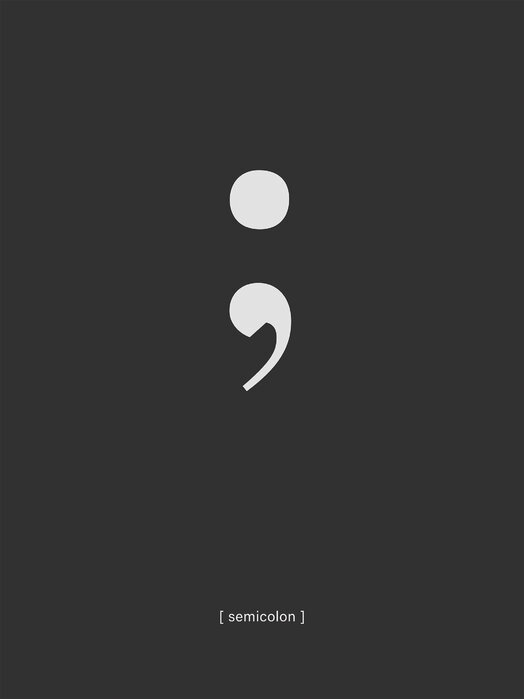
Ah, semicolon.
You tiny, chaotic line.
You confusing piece of punctuation that somehow manages to be both elegant and catastrophic.
In one moment, you’re the bridge that holds my code together. In another, you’re the reason my entire build fails at 11AM while I stare at the screen wondering what choices led me to this moment.
But still, I adore you.
How Did We Even Get Here?
The semicolon (;) is the unsung anti-hero of programming languages. It’s not flashy. It’s not fancy. It doesn’t have the flair of curly braces or the authority of the exclamation mark. But what it does have is power.
Languages like C, C++, Java, JavaScript, and even C# (my beloved) rely on the semicolon as a statement terminator. It tells the compiler, “Yo, that’s the end of this thought. Move on.”
This use of the semicolon dates back to the early days of C, where Dennis Ritchie and Brian Kernighan (those dudes again) designed it as part of the syntax to keep things clean, readable, and modular.
Seems chill, right?
But here’s where the drama starts.
JavaScript and the Art of Pretending You Don’t Exist
You ever deal with someone who says, “You don’t need me,” but the second you ignore them, everything falls apart?
That’s JavaScript and semicolons.
JavaScript uses a controversial feature called ASI (Automatic Semicolon Insertion), which basically says: “Hey, I might add the semicolon for you… but like, maybe not.” This creates bugs so mysterious, Stack Overflow has entire cults formed around them.
The Great Dev Divide: To Semi or Not to Semi?
The semicolon has become a surprisingly divisive topic in the dev world. It’s the pineapple-on-pizza debate of coding.
Some devs love it. Some hate it. And some live in fear of leaving it out in case it breaks the build, brings down the prod server, and ruins your reputation in one fell swoop.
And even when a language doesn’t require it, like Python or Go; your fingers still reach for it out of habit. Like muscle memory… or trauma.
But Here’s the Thing…
The semicolon represents more than syntax.
It represents boundaries.
Structure.
The end of one thought before beginning another.
It’s the sigh after a long sentence.
It’s a pause that says, “Wait, I’m not done; but I need a second.”
And if that isn’t the most relatable line of code I’ve ever met, I don’t know what is.
So Yes, I Will Keep Loving You
Even if you break my app.
Even if you haunt my dreams.
Even if some languages want to pretend they don’t need you.
Because sometimes… a tiny line is the only thing holding everything together.
Enjoyed this digital love letter?
Then you’re in luck; because I write these semi-emotional, semi-technical takes all the time.



 Days in the Life of Mo
Leave a Reply