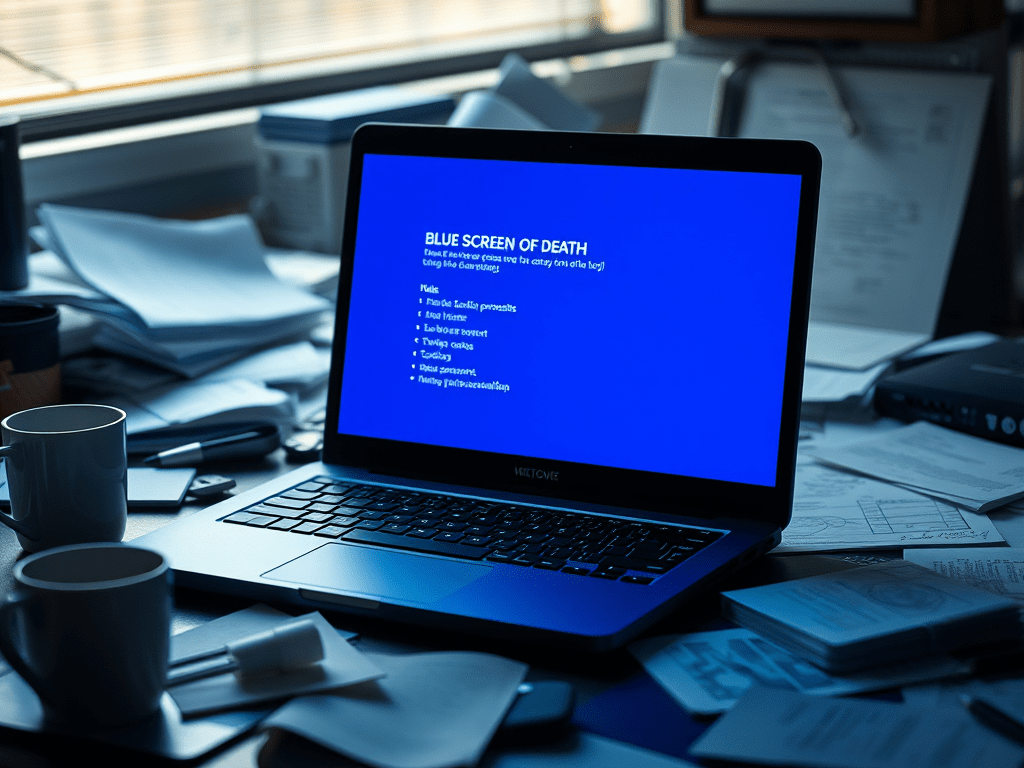
It started with a sound.
That soft, innocent whirr of a machine trying to stay alive. Then… silence. Followed by the bluest blue I’ve ever seen.
There it was.
The legendary, the feared, the drama queen of all errors; The Blue Screen of Death.
You know that feeling when your stomach drops faster than your Wi-Fi signal during a Teams meeting? That’s the one.
At first, I thought it was just a glitch. Maybe Windows was tired. Maybe my laptop needed a break; honestly, same. But then those words appeared, white text on blue background, calm yet horrifying:
“Your PC ran into a problem and needs to restart.”
And just like that, my day spiraled into a Greek tragedy written in C#.
When Blue Means Doom
The “Blue Screen of Death” (or BSOD for those of us who’ve suffered enough to earn the acronym) isn’t new. It’s been around since the early 1990s, introduced by Microsoft as a “stop error screen” , basically Windows’ way of saying, “I’ve made a huge mistake, and you’re going to pay for it.”
According to Microsoft’s official documentation, a BSOD happens when the operating system hits a critical error it can’t recover from; usually due to faulty drivers, failing hardware, or software conflicts.
But here’s the thing, the blue screen doesn’t just crash your computer. It crashes your spirit.
One moment, I was a productive developer deep in the zone. The next, I was a philosopher staring into the void, wondering if this was karma for ignoring Windows Updates.
Stage One: Denial
“Oh, it’s fine. It’ll restart. It always restarts.”
Spoiler: it did not restart.
You sit there, blinking at the blue abyss, half-expecting it to apologize. But no, it just sits there smugly, QR code and all, like:
“Here’s a link that won’t help you. Good luck.”
I scanned the code once. It led me to a page titled ‘Troubleshooting Stop Errors’. The irony? The page froze halfway through loading.
I laughed. Then I cried. Then I opened my old laptop like I was summoning an ancient relic.
Stage Two: Anger
Suddenly, I became a one-woman IT department. I was Googling things like “KERNEL_MODE_HEAP_CORRUPTION” and “why does my computer hate me personally.”
According to a 2023 study from Statista, hardware issues are responsible for roughly 37% of BSOD cases. The rest? Driver conflicts, bad updates, or, my personal favorite, “unknown causes.”
Unknown.
As in, “we have no idea, good luck out there soldier.”
Meanwhile, my deadline was approaching faster than Windows could collect error info (which, by the way, has never once made it to 100%).
Stage Three: Bargaining
I found myself whispering to the machine like a toxic ex.
“Please, just turn on. I’ll clean your disk. I’ll stop ignoring the updates. I’ll even uninstall Chrome extensions. Just… boot.”
At this point, I had flashbacks to every time I’d clicked “Remind me later.” Maybe Windows wasn’t the villain. Maybe I was.
Stage Four: Acceptance (and a Tiny Bit of Resurrection)
Eventually, I did what all developers do when things break: I entered troubleshooting mode with the emotional stamina of a caffeinated raccoon.
Safe Mode? Tried it.
System Restore? Failed.
Prayers? Constant.
Finally, I discovered the culprit, a corrupted driver file from an overenthusiastic third-party update. Classic.
With a few lines of command prompt magic and a restart, the blue screen faded away. My desktop reappeared like a phoenix rising from the ashes (of my mental stability).
I won.
Or at least… I survived.
The Lesson in the Blue
The Blue Screen of Death isn’t just a system error. It’s a humbling reminder that technology, no matter how advanced, is still capable of having bad days… just like us.
It’s a metaphor for burnout, really. You push too hard, ignore the warning signs, and then one day you just… stop responding.
But like any good developer, you troubleshoot, debug, and reboot. Because that’s what we do; with code, with life, with everything that unexpectedly crashes.
So here’s to the blue screens, the bugs, and the moments when your patience hits 0%. They teach us resilience, and the importance of backing up literally everything.
Subscribe for more dev tales, caffeine-fueled chaos, and painfully relatable moments from your local tech girl who now keeps her drivers (and emotions) fully updated.

 Days in the Life of Mo
Leave a Reply