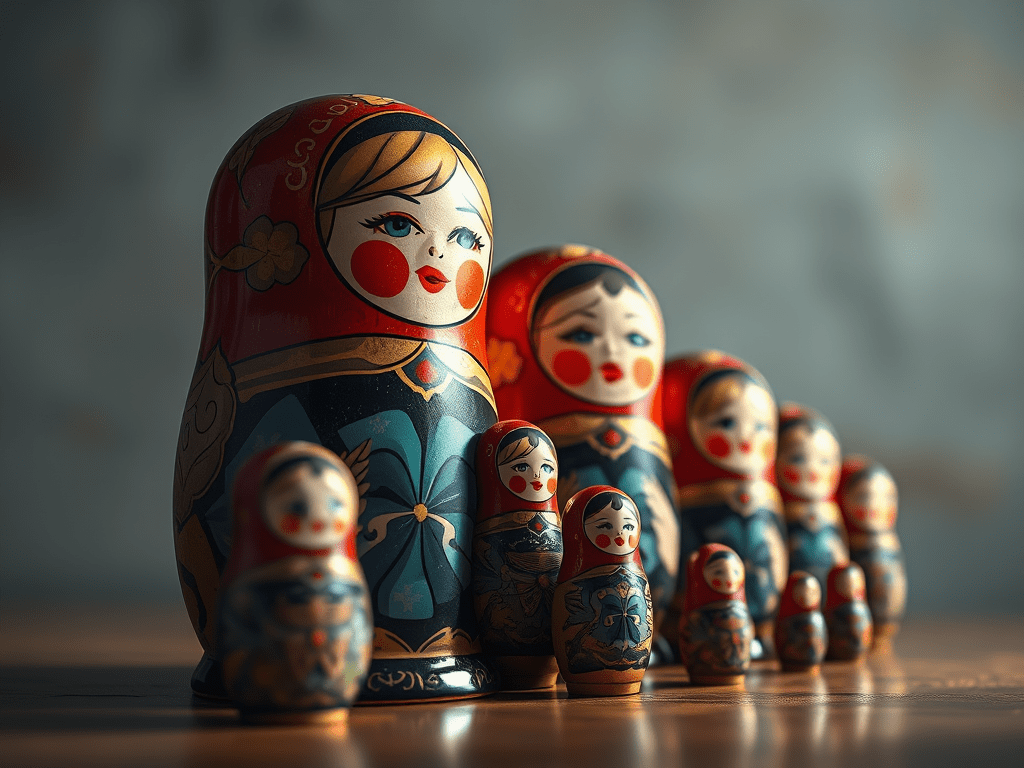
There’s a moment every developer remembers: the first time recursion finally makes sense. For some, it’s during a late-night coding session with lofi beats and emotional damage. For others, it’s after a senior dev explains it five times and then just sighs, “Imagine a snake eating itself.”
For me?
It was Russian nesting dolls.
You know those wooden dolls that open to reveal a smaller one inside… and then another… and then another, until you’re staring at a tiny, judgmental baby doll that seems to whisper, “You couldn’t figure this out sooner?”
Yeah. Those ones.
Recursion is exactly that.
A function that keeps calling itself, each time with a smaller version of the same problem; just like opening each doll until you reach the base case: the smallest doll that can’t (or won’t) open anymore.
And suddenly recursion stops being that mysterious creature haunting CS textbooks and becomes… well, a wooden doll with separation issues.
Let’s Break It Down (Gently, because recursion can hurt feelings)
Imagine you write a function to count the number of dolls inside the biggest one:
- Big doll opens → sees smaller doll → calls function again for smaller doll.
- Smaller doll opens → sees even smaller doll → calls function again.
- Repeat until you hit the baby doll, who refuses to open because she has boundaries.
That’s your base case.
This is literally what your code is doing.
The computer keeps peeling things back until there’s nothing left to peel.
And if you don’t give that function a stopping point, if you don’t tell the recursion “hey, stop when you get to this size”, it keeps going forever. Which is exactly how you end up with a stack overflow error and a Google search history you don’t want anyone seeing.
Speaking of which… did you know recursion is formally defined in the Stanford Encyclopedia of Philosophy as a process where “a function is defined in terms of itself”?.
Yep, philosophers use recursion too. It’s not just us and our emotional support caffeine.
A Quick Real-Life Example (Because developers love trauma bonding)
Think about writing an email.
You start typing…
Then you realise the paragraph needs explaining…
Then the explanation needs explanation…
Then you start wondering why you didn’t just become a barista.
That’s basically recursion.
Each explanation is a smaller version of the same idea. You go deeper and deeper until you hit your base case:
“I’m not explaining this anymore.”
Why Russian Dolls Are Actually Perfect for Teaching Recursion
Russian nesting dolls (also called Matryoshka dolls) historically symbolize motherhood, continuity, and infinity. According to The Guardian, the first set was created in the 1890s as a metaphor for “stories inside stories” and “selves within selves.” If that’s not recursion energy, I don’t know what is.
Every doll holds another.
Every function call holds another.
Every dev Googles the same question again.
Balance. Harmony. Chaos.
But let me ask you something…
What was your “aha!” moment with recursion?
Was it a YouTube video? A lecture? A meme?
Or did you, like most of us, pretend to understand it until you actually did?
Drop your moment in the comments—I genuinely want to know how many of us suffered in silence together.
Before You Go…
If you enjoyed opening these metaphorical dolls with me, you might enjoy hanging out here more often.
Subscribe for more: tech explained casually, occasionally dramatically, always honestly; from your Bloemfontein dev girl with a keyboard, curiosity, and a questionable number of Chrome tabs.

 Days in the Life of Mo
Leave a Reply