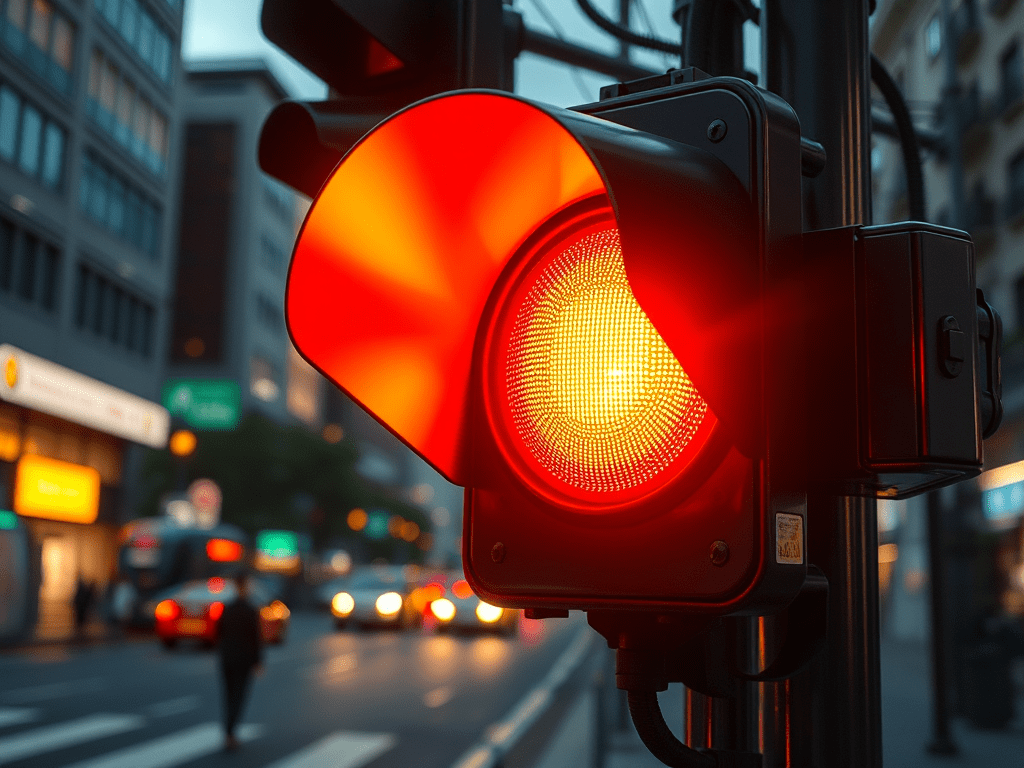
You sit at a red light, drumming your fingers on the steering wheel. You’re having a one-sided standoff with a colored bulb. It’s been 45 seconds. You’re losing. You wonder, “Is this thing broken? Does it even know I’m here?”
My friend, it knows. It knows exactly you’re there. And it’s not just a light; it’s the most public-facing node in a vast, hidden network having a conversation about traffic flow, pedestrian safety, and your impending lateness.
Welcome to the invisible language of traffic lights. This isn’t just about stop and go. This is a story of sensors, algorithms, and a little bit of traffic-light drama. Let’s pull back the curtain.
The “Dumb” Light Myth: A Tragedy in Three Colors
We’ve been lied to. The classic traffic light; a simple timer cycling through red, yellow, and green, is the rotary phone of transportation. It’s charmingly obsolete. For decades, this was the standard: a pre-programmed loop, utterly oblivious to the five-car pileup on one side and the utterly empty road on the other.
As traffic engineer Henry Barnes noted in his mid-20th century work, the goal was simply to create “green waves”; timing lights so a car moving at a specific speed would hit a string of greens. It was elegant, but dumb as a post. It couldn’t adapt. It couldn’t listen.
The Sixth Sense: How Lights “See” and “Feel”
This is where the magic begins. The modern light is a sensory powerhouse. It’s not just talking; it’s gathering intelligence. How?
- Inductive Loops: Those mysterious black circles cut into the asphalt? Those are inductive loop detectors. They’re essentially giant metal detectors for your car. When you stop over one, your car’s metallic mass changes the loop’s inductance, sending a signal to the traffic light’s brain: “Psst… we’ve got a live one over here.”.
- Cameras & Radar: Those little black spheres or boxes on top of lights? They’re watching. But not for speeding tickets (usually). These video detection systems use algorithms to identify vehicles, count them, and even classify their type. A bus might get priority over a sedan. It’s traffic-based favoritism.
- The Humble Button: The pedestrian cross button is the most visceral form of this communication. You press it. You’ve sent a message. You’ve told the system, “A human would like to cross here, please and thank you.” (Whether it listens immediately is a whole other story of algorithmic prioritization).
The Brain in the Cabinet: It’s Getting Emotional in Here
All this sensory data flows to one place: the traffic signal controller, a rugged computer housed in a metal cabinet on the nearby sidewalk. This is where the conversation happens.
This isn’t a simple on/off switch. This is a logic-driven manager making real-time decisions. Using complex algorithms (often based on standards like the NTCIP – National Transportation Communications for ITS Protocol), it weighs its inputs.
- “Okay, I’ve got eight cars on Oak Street, but a pedestrian just pressed the button on Pine. Do I give Oak a few more seconds of green, or do I service Pine?”
- “It’s 3 AM. There’s one car sitting at a red light with no other traffic for miles. Do I make them wait, or do I break protocol and give them a green?”
The system uses logic to optimize for the greatest good: maximum traffic flow. But it also must consider the frustration of a lone driver at midnight, the safety of a school crossing.
The Networked Neighborhood: When Lights Gossip
But the conversation doesn’t stop at one intersection. Modern adaptive systems like SCOOT (Split, Cycle, and Offset Optimization Technique) or SCATS (Sydney Coordinated Adaptive Traffic System) take this to the city level.
Individual intersections talk to each other! They share data. “Hey, intersection #42, I’ve got a huge platoon of cars heading your way. Get ready for them.” This creates those magical “green waves” you sometimes experience, where you hit every light perfectly. It wasn’t luck; it was a coordinated digital conversation you blissfully drove through.
The Moral of the Story: You Are a Data Point (A Very Important One)
The next time you’re at a light, remember: you’re not just waiting. You’re participating in a complex, invisible dialogue between infrastructure and humanity. You are a data point in a city-sized algorithm designed to keep us all moving safely.
It’s a beautiful, complicated dance of technology and civic life. It’s not perfect; we’ve all been stuck at a stubborn red light with no one in sight, but it’s a world away from the simple timed loops of the past.
So, show a little respect. That light isn’t just a colored bulb. It’s a sentinel. It’s listening.
Fascinated by the hidden tech that runs our world? Join a community of the curiously minded! Subscribe to get these little revelations delivered straight to your inbox. No spam, just the good stuff, uncovering the secret conversations happening all around us.



 Days in the Life of Mo
Leave a Reply to tlover tonet Cancel reply